
It is the third part of the cycle of the three Marian feasts: the Birthday of Our Lady (September 8), the Holy Name of Mary (September 12) and her Presentation in the Temple (November 21), parallel with the first three feasts of our Lord in the liturgical cycle: the birth of Christ or Christmas (December 25), the Holy Name of Jesus (January 3), and His Presentation in the Temple (February 2).
The account is not recorded in the New Testament. It comes from the Protoevangelium of James, a second-century apocryphal text which recounts that Joachim and Anne offered Mary at age three in gratitude for the birth of their long-awaited child.
The feast began in the Eastern Church around the sixth century—linked to the dedication of the Basilica of Saint Mary the New in Jerusalem—and spread to the West, entering the universal Roman liturgical calendar in the fifteenth century.
Rather than focusing strictly on literal historical details, the Church highlights Mary’s complete dedication to God from her earliest years, preparing her for her role in the Incarnation.
Mary is formed in the Old Testament Temple so she can become the “living Temple” of the New Covenant, bearing Christ.
Through her attentiveness and obedience to God’s will, Mary serves as a model for all Christians, who are also called to offer themselves to God and become temples of His grace.
In 1953, Pope Pius XII linked November 21 with the annual commemoration of cloistered religious life, reflecting Mary’s childhood dedication to prayer and solitude in the Temple.
La Présentation de la Vierge Marie est une fête liturgique catholique célébrée chaque année le 21 novembre, qui commémore l’offrande de Marie enfant au Temple de Jérusalem pour être consacrée à Dieu.
C’est le troisième volet du cycle des trois fêtes mariales : la Nativité de Notre-Dame (8 septembre), le Saint Nom de Marie (12 septembre) et sa Présentation au Temple (21 novembre), en parallèle avec les trois premières fêtes de notre Seigneur dans le cycle liturgique : la naissance du Christ ou Noël (25 décembre), le Saint Nom de Jésus (3 janvier) et sa Présentation au Temple (2 février).
Cet épisode ne figure pas dans les quatre Évangiles canoniques, mais provient d’un texte apocryphe ancien, le Protévangile de Jacques.
Selon la tradition, ses parents, sainte Anne et saint Joachim, l’ont conduite au Temple vers l’âge de trois ans pour remercier Dieu et lui consacrer leur fille. Comme l’explique Présentation de Marie au temple, le message spirituel est que le cœur de Marie est dès l’origine entièrement dédié à Dieu.
La fête trouve son origine à Jérusalem avec la dédicace, en 543, de la basilique Sainte-Marie-la-Neuve près de l’esplanade du Temple.
Elle s’est diffusée progressivement en Occident (notamment aux XIVe et XVe siècles) et a été fixée au 21 novembre dans le calendrier liturgique.
La Présentation illustre l’offrande totale de soi et l’accueil de la volonté divine, qui culminera dans le « oui » (cf le “fiat“) de l’Annonciation. Elle devient le tabernacle qui accueille le Christ
Marie est contemplée comme un « temple vivant » et la nouvelle Arche d’Alliance, appelée à porter en elle le Fils de Dieu incarné, tout en restant subordonnée à l’unique médiation du Christ.
Cette fête invite chaque baptisé à offrir sa vie à Dieu et à devenir, selon saint Paul, un temple de l’Esprit Saint.
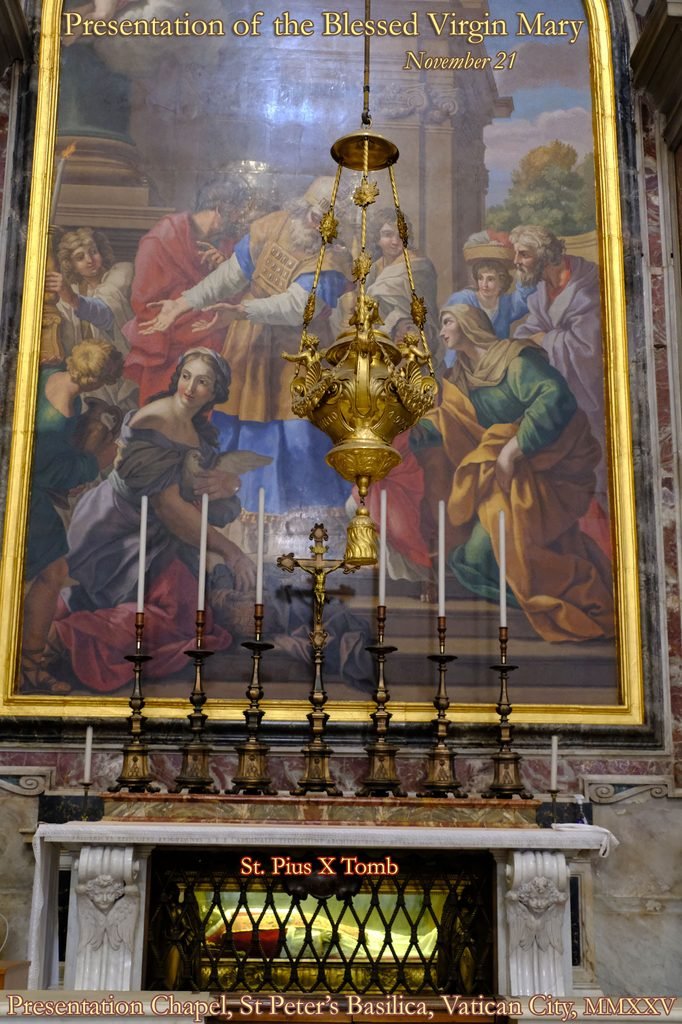
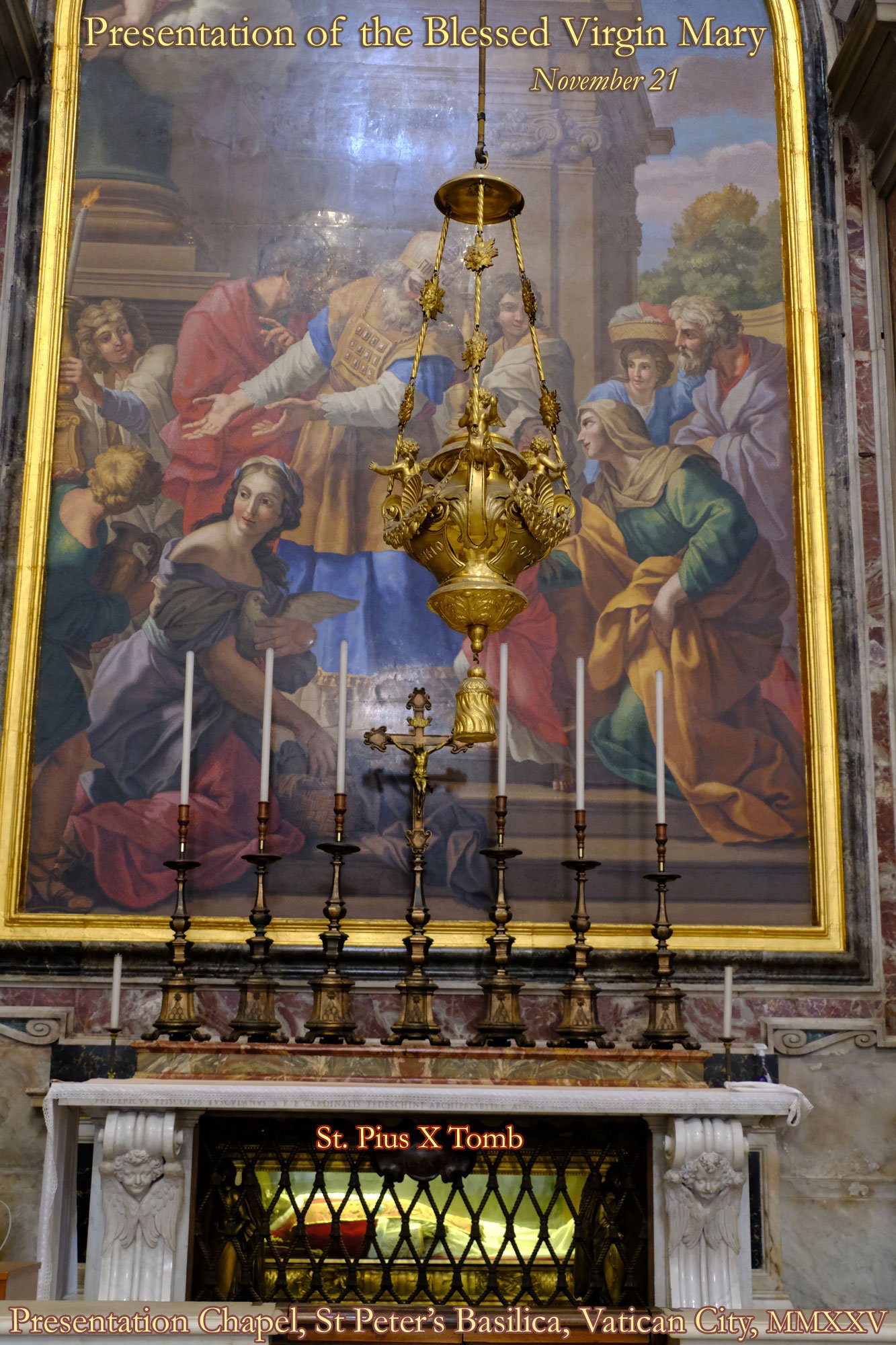
Photo above: the mosaic altarpiece was completed by Pietro Paolo Cristofari in 1728 and is based on a painting by 17th-century artist Giovanni Francesco Romaneli, the original of which can be found in Rome’s Basilica di Santa Maria degli Angeli e dei Martiri. It is the Presentation of the Virgin Mary in the Temple by her parents (detailed photo and explanation here).
Below the altar is the body of St. Pius X (1904-1914), the last pope to be canonized.
Let’s pray, prions (Latin Mass Propers):
Deus, qui beátam Maríam semper Vírginem, Spíritus Sancti habitáculum, hodiérna die in templo præsentári voluísti: præsta, quǽsumus; ut, ejus intercessióne, in templo glóriæ tuæ præsentári mereámur.
O God, Who wast pleased that on this day the Blessed Virgin, the dwelling-place of the Holy Spirit, should be presented in the Temple, grant, we beseech Thee, that, by her intercession, we may deserve to be presented in the temple of Thy glory.
Ô Dieu, qui avez voulu qu’en ce jour la bienheureuse Marie, toujours Vierge, demeure de l’Esprit-Saint, soit présentée au Temple, faites, nous vous en supplions, que, par son intercession, nous méritions d’être présentés dans le temple de votre gloire.