Scholars and Catholic tradition widely identify Bartholomew with Nathanael, a man from Cana in Galilee mentioned in the Gospel of John. “Bartholomew” is a patronymic name meaning “son of Talmai”. Philip introduced Nathanael to Jesus. When Jesus saw him, He praised him as “a true Israelite in whom there is no guile.” Surprised, Nathanael asked if anything good could come from Nazareth, but after speaking with Jesus, he immediately professed, “Rabbi, you are the Son of God; you are the King of Israel.”
After Christ’s Ascension and Pentecost, tradition holds that Bartholomew traveled far to preach the Good News, including regions like India, Mesopotamia, Persia, Egypt, and Armenia.
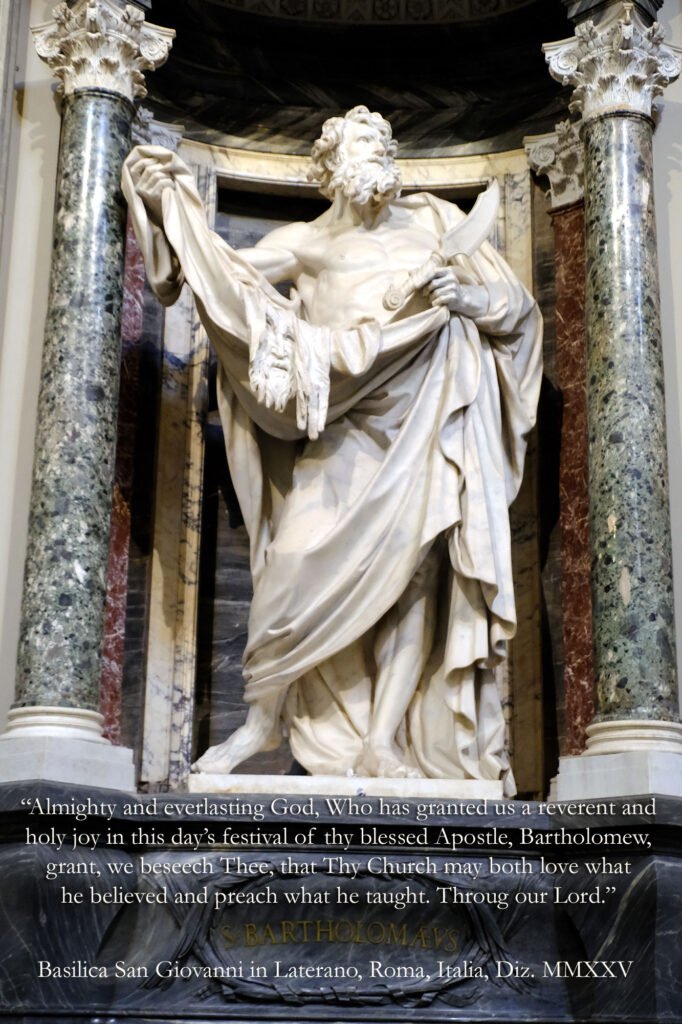
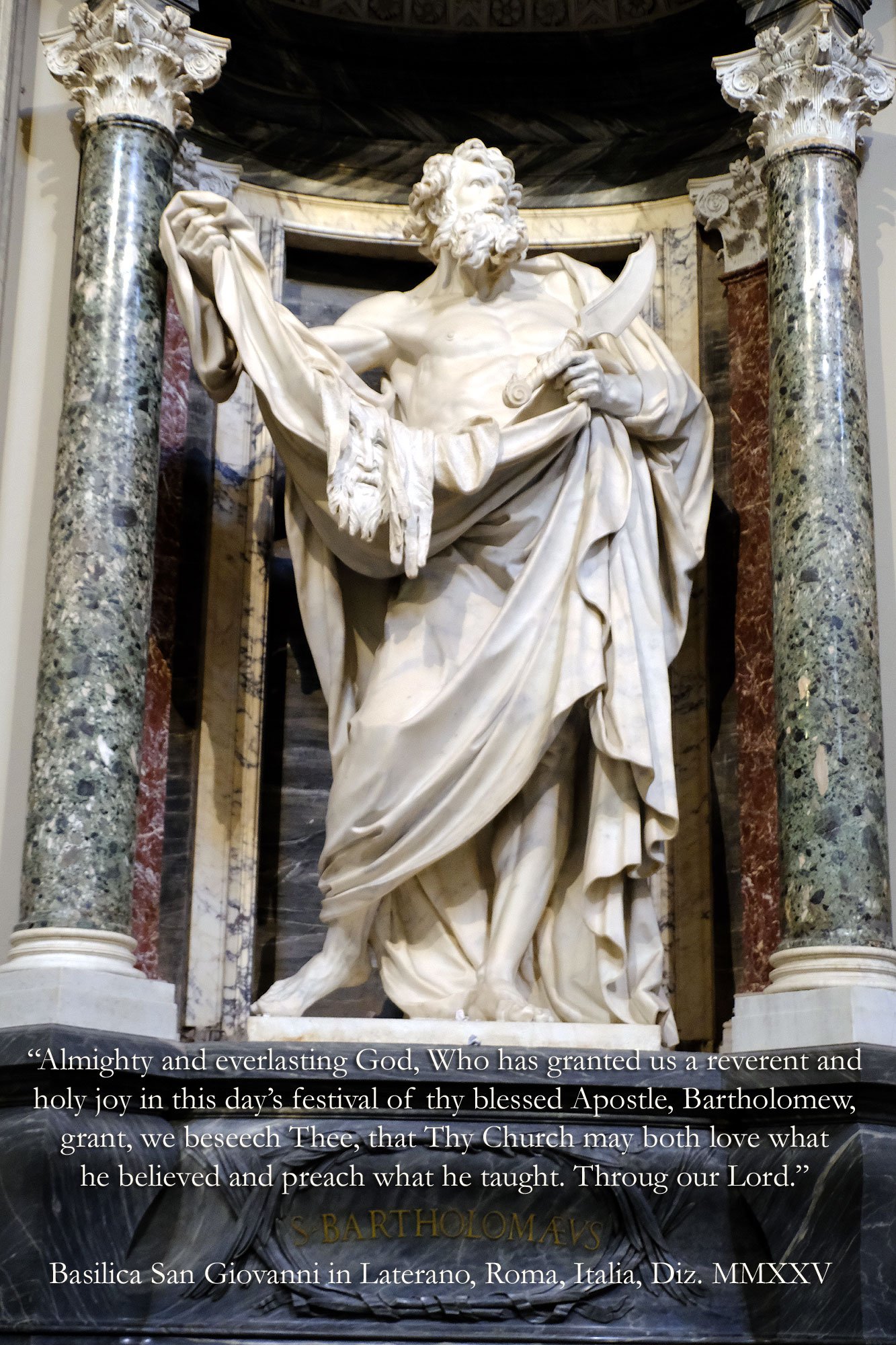
He was martyred in Albanopolis (in Armenia). Pagan priests and rulers turned against him after he converted local royals. He was flayed alive (skinned) and then beheaded for his faith. Because of the manner of his death, sacred art (such as Michelangelo’s Last Judgment in the Sistine Chapel) often depicts Saint Bartholomew holding a butcher’s knife or his own skin. So does this Statue (photo above),
a 14 feet high Marble statue of Saint Bartholomew designed by the 18th-century French sculptor Pierre Legros II (Archbasilica of St. John Lateran, Rome) with the collect of the Mass of the day.
L’apôtre Saint Barthélemy est l’un des douze disciples choisis par Jésus-Christ, célébré le 24 août par l’Église catholique, mais son nom en France est lourdement associé au tragique massacre de la Saint-Barthélemy.
La tradition catholique identifie souvent Barthélemy à Nathanaël, originaire de Cana en Galilée. Saint Jean raconte que Jésus l’a vu sous un figuier et l’a salué comme un « véritable fils d’Israël, un homme qui ne sait pas mentir ». Après la Pentecôte, la tradition indique qu’il a évangélisé des régions lointaines comme l’Inde, la Mésopotamie et l’Arménie. Il aurait subi le martyre en Arménie en étant écorché vif puis décapité. L’art chrétien le représente souvent tenant un couteau et sa propre peau, comme dans le Jugement dernier de Michel-Ange à la chapelle Sixtine. Il est le saint patron des métiers du cuir (tanneurs, relieurs).
En France, la date de sa fête rappelle le massacre de la Saint-Barthélemy survenu le 24 août 1572 à Paris, point culminant des Guerres de Religion entre catholiques et protestants (huguenots). Ce jour-là, des milliers de protestants venus pour un mariage royal furent assassinés, éclipsant durablement la figure spirituelle de l’apôtre dans la mémoire collective française.