
Born on December 9, 1579, in Lima, he was the illegitimate, mixed-race son of a Spanish nobleman (Don Juan de Porres) and Ana Velázquez, a freed slave woman from Panama.
He grew up in severe poverty, apprenticed as a barber-surgeon at age 12 to learn traditional medicine and wound care, and spent long nights in prayer.
Due to colonial laws that barred mixed-race individuals from full religious orders, he entered the Holy Rosary Priory in Lima at age 15 as a donado (a volunteer/helper). He later took vows as a Dominican lay brother in 1603, choosing to perform menial tasks like cleaning, cooking, and doing the laundry with joy.
Placed in charge of the monastery’s infirmary, he treated everyone—from wealthy noblemen to poor enslaved Africans and street beggars—without distinction of race or status.
He founded an orphanage and a hospital for abandoned children, distributed food and alms daily, and cared for animals.
He was reported to have experienced ecstasies, bilocation (being in two places at once), miraculous cures, and a gentle rapport with animals.
Canonization and Patronage: Beatified in 1837 by Pope Gregory XVI and canonized on May 6, 1962, by Pope John XXIII, he is celebrated as the first Black/mixed-race saint of the Americas.
His feast day is November 3. He is the patron saint of mixed-race people, social justice, public health workers, barbers, hairdressers, and race relations.
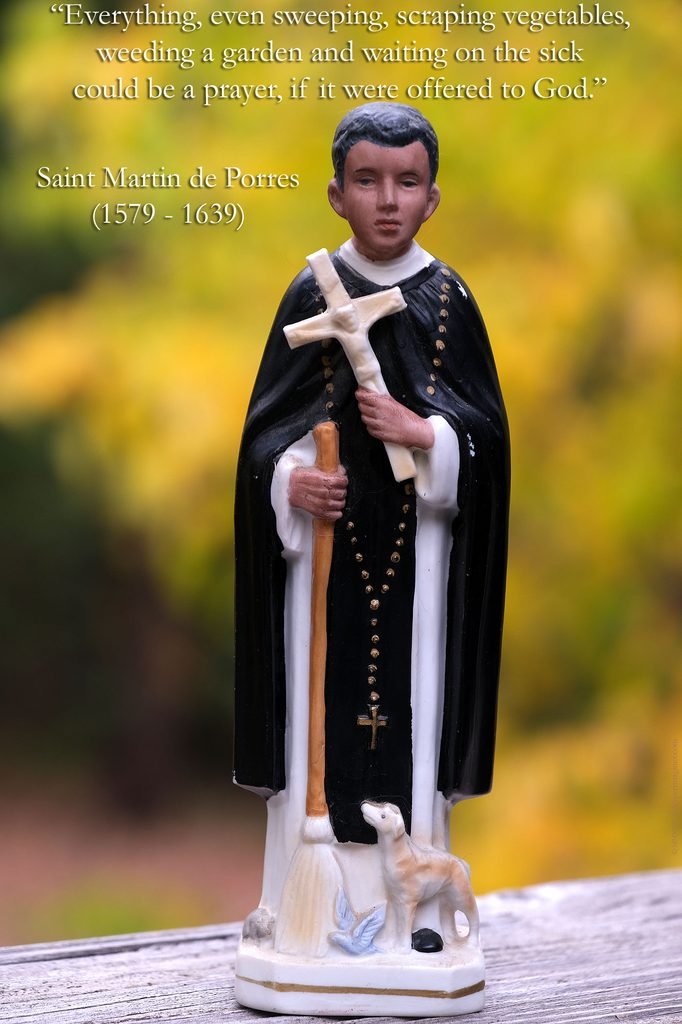
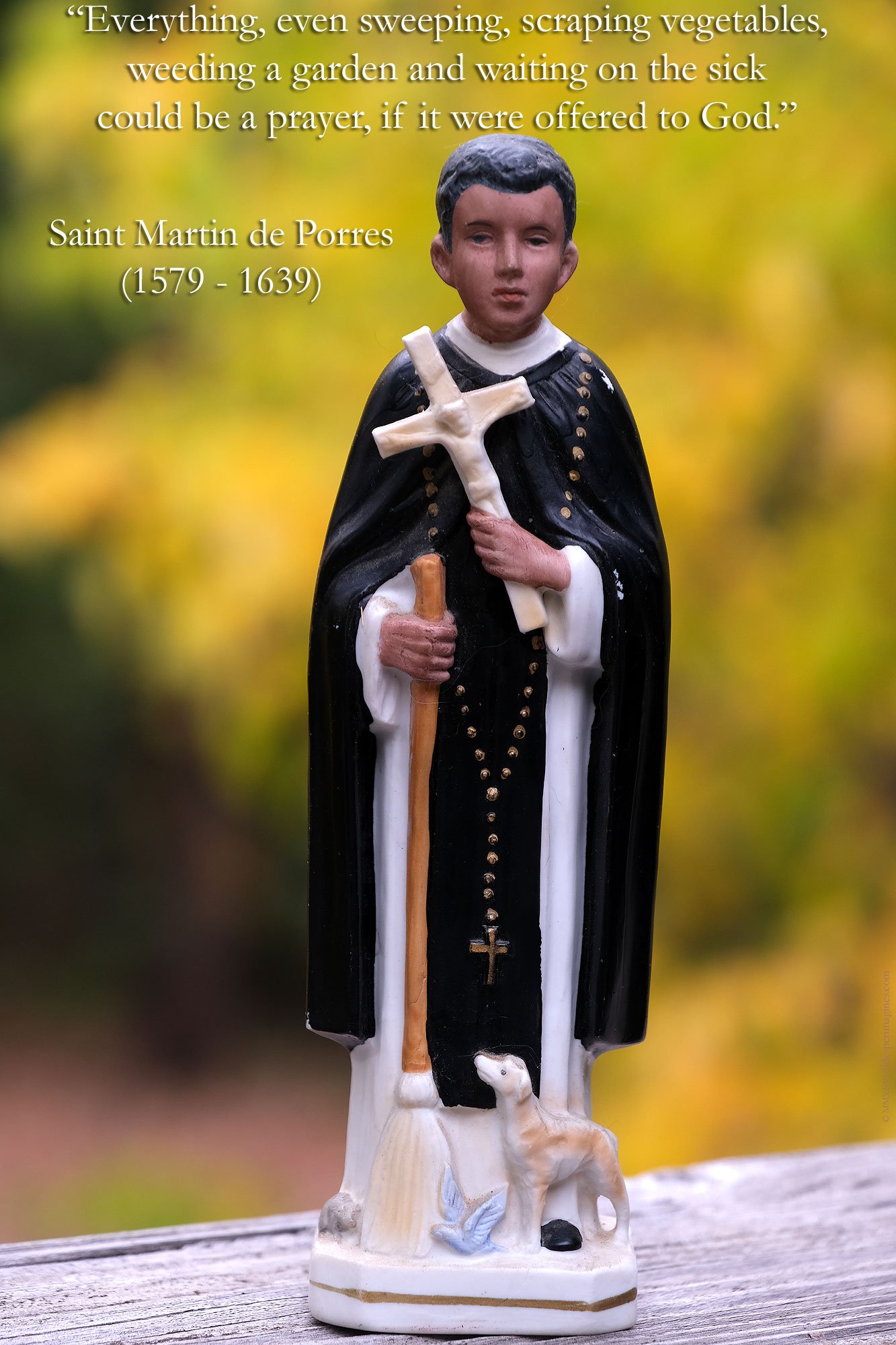
He is traditionally depicted in the habit of a Dominican lay brother with a broom (symbolizes his life of humble service, hard work, and his willingness to perform the lowestly domestic chores in the friary), a dog, a cat, and a mouse (it represents his deep love for all creation and his famous gift for bringing peace to animals – traditionally shown sharing food from the very same dish to symbolize harmony and God’s peace). He is also frequently shown with a crucifix, a rosary, or a heart, reflecting his intense spiritual devotion and care for the sick and poor.
Saint Martin de Porrès (1579–1639) est un religieux dominicain péruvien, célébré dans l’Église catholique le 3 novembre. Connu comme « l’apôtre de la charité » et le patron de la justice sociale, sa vie est un modèle d’humilité et de service envers les plus rejetés.
Né à Lima (Pérou) d’un noble espagnol et d’une ancienne esclave noire péruvienne (mulâtresse), il a souffert dès l’enfance des préjugés liés à sa naissance illégitime et à la couleur de sa peau.
À 22 ans, il est admis au couvent du Rosaire à Lima en tant que tertiaire (donné / frère laïc), refusant les honneurs et choisissant les tâches les plus modestes, comme le ménage et l’infirmerie. Son balai et la Croix étaient ses plus grands compagnons.
Ancien apprenti barbier-chirurgien, il met ses connaissances en médecine et en soins au service des pauvres, des esclaves, des Indiens et des malades de la ville.
Une grande douceur le caractérise envers les animaux, et la tradition lui prête plusieurs dons extraordinaires (bilocation, guérisons) qu’il cherchait toujours à cacher.
Reconnaissance par l’Église : Béatifié en 1837 par Grégoire XVI, il a été canonisé le 6 mai 1962 par le pape Jean XXIII, qui a souligné la profondeur de sa prière eucharistique et de sa charité universelle.
Connu aussi sous le nom de Martin de la Charité ou Fray Balai, il est fréquemment représenté avec un balai et un chien en raison de sa vie et de ses attributs symboliques.
Citation sur la photo ci-dessus “Tout, même balayer, racler des légumes, désherber un jardin et soigner les malades, peut être une prière, si cela est offert à Dieu.”